Join us for a fun-filled weekend of strategizing, solidarity, and celebration!
All events will be happening at the Voyageur Inn (200 N. Viking Dr. N.) in Reedsburg, WI.
You can book your room directly with them (mention you are coming for the FFD event for the best rate: https://voyageur-inn.com/ 608-524-6431) Let us know if you would like to share a room! Limited travel stipends are also available – let us know if you need assistance in order to participate!
Fri. Dec. 4th 6:00 pm Kick-off screening of the acclaimed documentary, Bad River, about the indigenous-led struggle against the Line 5 tarsands pipeline in northern, WI. https://www.badriverfilm.com/
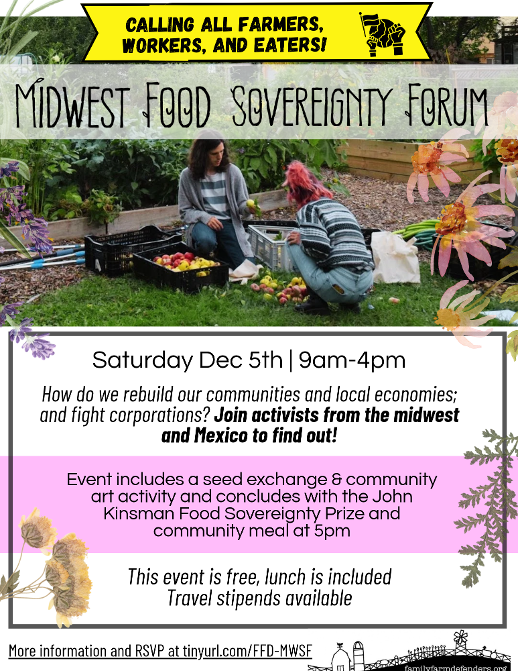
Sat. Dec. 5th 9:00 am – 4:00 pm Midwest Food Sovereignty Forum! In the democratic style of the Nyeleni Process aligned with the international work of La Via Campesina, we will take the day to share resources, ideas, art, music, stories, and strategies in the struggle for the people’s right to define their own food and agriculture systems.
The event will feature a mística, food sovereignty intro, noontime panel discussion with representatives from Mexico’s Movimiento Agrícola Campesina (MAC translates to Agricultural and Peasant Movement – they led massive protests in Mexico City in November and will be continuing the fight this year), as well as breakout sessions, seed swap, and community art sharing.
We encourage all farmers, farmworkers, and eaters who are passionate about food sovereignty and want to make connections and learn more to attend!
To help us plan (and to make sure we have enough food for lunch) please register for the forum at: www.tinyurl.com/FFD-MWSF
Sat. Dec. 5th 4:00 pm Bonus screening of another award winning documentary, Déjà Vu, juxtaposing solidarity lessons of the U.S. farm crisis with the more recent farmer strike in India (featuring many FFD members!)
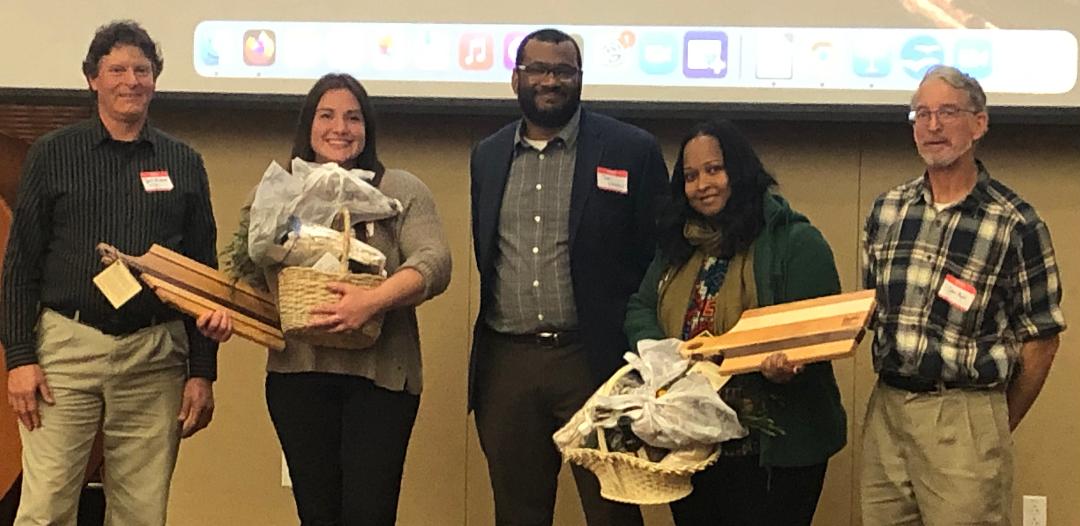
Joel Greeno (far left) and John Peck (far right) present John Kinsman Prize to Heather Gayton and Naima Dhore along with keynote speaker, Jahi Chappell, in 2022
Sat. Dec. 5th 5:00 – 9:00 pm John Kinsman Food Sovereignty Prize Banquet and Award Ceremony – featuring local food, keynote by our Mexican guests, as well as presentations by this year’s prize winners, followed by an open-mic and dance party! Suggested donation for the JK Prize Dinner is $35 (children are free!). Anyone who sponsors the John Kinsman Prize with $100+ donation to FFD will receive two (2) complimentary banquet tickets, plus mention in the program. To make your tax deductible donation online in advance, please visit our website: www.familyfarmers.org
Sun. Dec. 6th 9:00 am – 12:00 noon FFD annual meeting – including organizational updates, board and officer elections, as well as discussions about ongoing campaigns and future activities. The meeting is open to all members and allies!
From left to right, Joel Greeno, FFD President; 2022 JK Prize Winner, Heather Gayton of ZanBria Artisan Farms (Friendship, WI); Jahi Chappell, Director of the Michigan Satte University Center for Regional Food Systems; 2022 JK Prize Winner, Naima Dhore of Naima’s Farm (Alexandria, MN), and John Peck, FFD executive director
Each year FFD is proud to host the John Kinsman Food Sovereignty Prize – named in honor of John Kinsman, one of the founders and longtime president of Family Farm Defenders who passed away at the ripe old age of 87 on MLKJ Day, 2014. John was not only an early pioneer of organic grass-based dairying in the Midwest, but also a tireless champion of civil rights, social justice, and food sovereignty both in the U.S. and around the world.
Farmers, especially beginning farmers who have farmed for fewer than five years, and food sovereignty advocates are encouraged to apply.
To be considered for the prize, nominees must demonstrate the principles of food sovereignty through their farming practices, community engagement, outreach, public education, and/or organizing with farmers/farmworkers/land stewards to promote a more fair, resilient and agroecological food system.
Farming practices that demonstrate principles of food sovereignty would include sustainably managing natural resources, supporting healthy soil, and conserving biodiversity in small-scale production of livestock, fisheries, vegetables, fruits, fibers, flowers, herbs, or timber for local sale or distribution.
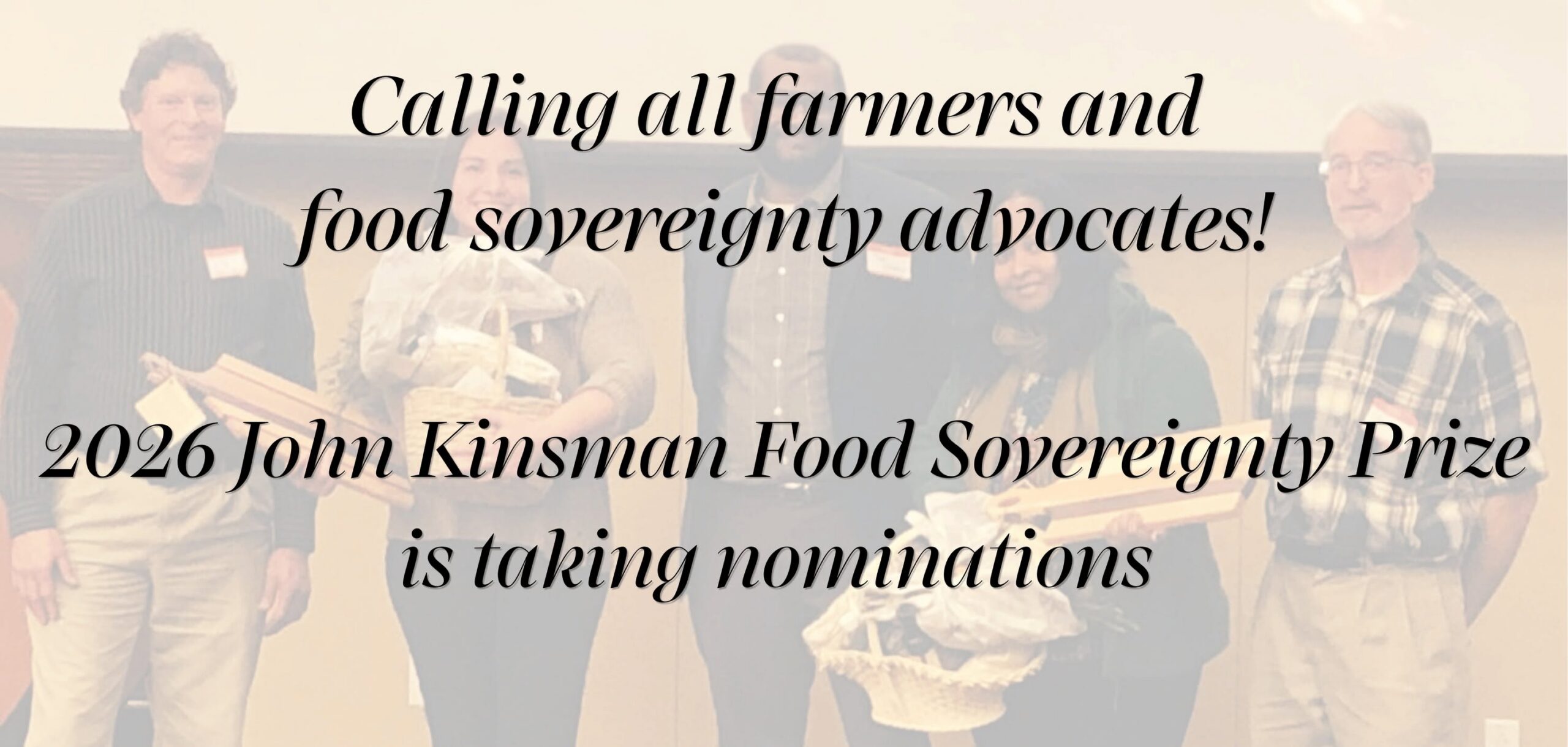
If you would like to nominate someone for the 2026 John Kinsman Food Sovereignty Prize, please send their name and contact info (phone, email, home address) to familyfarmdefenders@yahoo.com or leave a message at 608-345-3918.
Reminder, the deadline to submit nominations is Sun. Nov. 15th!
Evening award banquet will be happening in Reedsburg on Sat. Dec. 5th in conjunction with the FFD annual meeting and Midwest Food Sovereignty Forum. Check back here for more details about all the weekend activities!
Posted inUncategorized|Comments Off on Nominations Are Now Open For The 2026 John Kinsman Food Sovereignty Prize! Deadline 11/15!
From CAFOs to data centers, corporate America dodges local control
By: Raj Patel and Jim Goodman, Barn Raising Media, Aug. 27th, 2026
oday’s data center proponents argue such projects bring needed jobs and a boost to local economies. Rural America has heard confident pitches like these before. Nearly 40 years ago, concentrated animal feeding operations (CAFOs) arrived one barn at a time with bold promises of jobs and a county tax base.
By the time neighbors organized, right-to-farm laws and state preemption had severed the ground from under them. All the while, manure lagoons leached into the groundwater and fouled the air, shortening the life expectancy of the farmworkers and downwind neighbors.
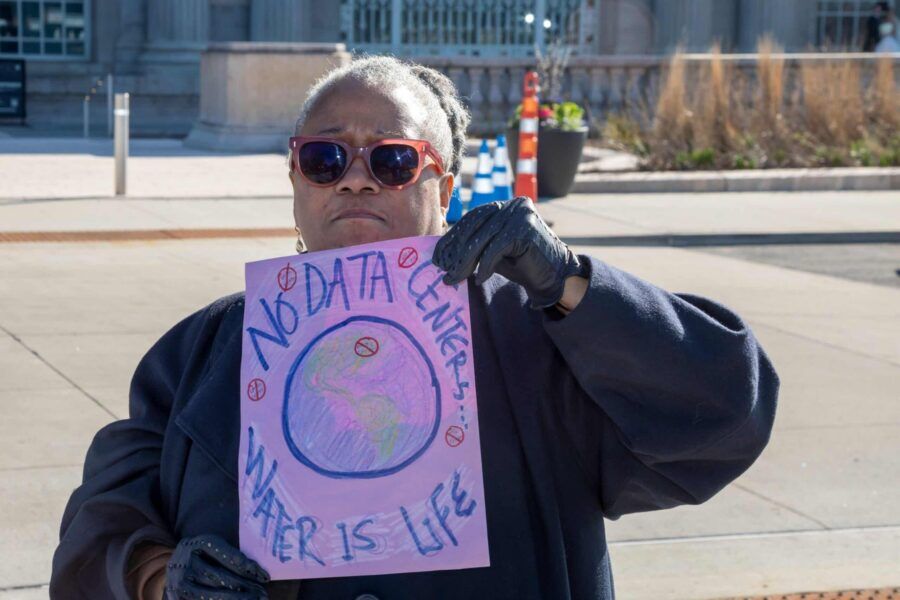
A rally against artificial intelligence data centers in Michigan in April, one of six protests held across the state. (Jim West, Alamy)
Organizing still won real things, to be sure, from North Carolina’s CAFO moratorium in 1997 to Chris Jones’s clean-water campaign for agriculture secretary in Iowa today. When it comes to CAFOs, the lessons came late, but in the age of artificial intelligence, those same lessons can give rural communities a leg up.
While CAFOs crept into rural America, data centers are arriving as a land rush. This speed is both terrifying and an advantage. Texas alone has some 248 proposed data center projects, even though 56% of Texans tell pollsters they do not want one nearby, which means that, unlike the CAFO era, rural communities are asking questions before the statutes are locked in. And rural people need their voices to be heard. According to Pew Research Center, of the more than 1,500 data centers proposed or under development, 67% are in rural communities.
The ultimate question will be: Do rural residents have the power to say no?
The answer is playing out across the country. In November 2025, 800 people filled a board meeting to oppose a billion-dollar Meta-linked project in Howell Township, Michigan, and the developer withdrew. In February, the city council of San Marcos, Texas, rejected a $1.5 billion campus after nearly nine hours of public comment, then became the first Texas city to ban data centers through its zoning code. Fort Worth, Texas, is drafting data center zoning rules of its own.
Opposition to data center projects is one of the few issues that many Americans agree on. A June Reuters/Ipsos poll found that only 14% of respondents would support a data center being built in their community. On July 18, organizers held 142 protests across 42 states in the first nationwide protest against data centers and artificial intelligence.
Data center hyperscalers are copying the CAFO playbook as best they can. West Virginia has stripped its counties and towns of the power to regulate data centers; similarly, the state’s right-to-farm law prohibits local governments from bringing civil or criminal action against an agricultural operation as long as it meets state and federal laws, permits and regulations. When Hill County, Texas, passed the state’s first county moratorium in May, a developer sued for $100 million and the county rescinded within a week, because Texas counties can zone against neither a data center nor a feedlot. Hood County pulled its own moratorium after state Sen. Paul Bettencourt (R-Houston) asked whether counties even hold that power; the same senator calls the San Marcos ban illegal.
Right-wing organizations like the American Legislative Exchange Council (ALEC), behind the pro-CAFO model legislation of right-to-farm laws since the 1990s, likewise appear intent on denying local control in the data center buildout. At its annual meeting in July, ALEC considered a model legislative framework that would undercut local bans and moratoriums and give data centers the “clear authority to secure power … subject only to objective safety and interconnection standards,” as the Center for Media and Democracy reported. The meeting featured speakers from Google and Nvidia, along with a Meta sponsorship.
The outburst of anti-data center sentiment ahead of the midterms has forced political leaders to reckon with the issue of local control. This is where data centers and CAFOs diverge. In June, Texas Republican Gov. Greg Abbott, who once hailed Texas as “the epicenter of AI development,” called for a ban on AI data centers in rural neighborhoods and a cut to their billion-dollar-a-year tax exemption after facing rare bipartisan pressure. Florida Republican Gov. Ron DeSantis signed a law to preserve local control over data centers. Michigan’s candidates for governor are split over the server halls sprouting between Lansing and Detroit. Illinois recently reversed course on its data center policy, reeling in the subsidies it had rolled out in 2019. And in July, New York became the first state in the nation to enact a one-year moratorium.
So, who hasn’t been able to say no? We pulled the locations of CAFOs and data centers in North Carolina and Texas, where the data is easily available, and—yes—got Claude to plot it for us against demographic and county boundaries.
In North Carolina the answer is pretty clear. The state’s 2,482 permitted animal operations cluster in the Black Belt coastal plain where the epidemiologist Steve Wing found hog lagoons a generation ago. Weighted by the number of permits each county holds, those counties are 46% people of color, against 34% across North Carolina’s hundred counties as a whole. Duplin County alone holds over 500 permits and 2.2 million allowable hogs in a county where almost half the population of 49,000 are people of color.
Data centers are the inverse of CAFOs. The state’s data centers sit in counties whiter than the state average, in the Piedmont towns that lost their historic furniture and textile businesses as well as in wealthy Wake and Mecklenburg counties (respectively home to large cities Raleigh and Charlotte). Two of the state’s suspended projects are in adjacent Edgecombe County and Pitt County, where residents informed their resistance based on their history fighting CAFOs.
In 1995, residents of predominantly Black Kingsboro, in Edgecombe County, successfully blocked a major meatpacker from building a 300-acre slaughterhouse in their backyard through efforts to rezone land. When a $19 billion, 400-acre data center came knocking three decades later, residents opposed it en masse. The developer Energy Storage Solutions withdrew its proposal in July and by August, Edgecombe County enacted a two-year moratorium.
In Texas the pattern is a little more complex. Rural Texas tends to be whiter than a state average balanced by majority-Hispanic cities. Yet the feedlot Panhandle is majority-Hispanic meatpacking country, with counties like Deaf Smith and Castro where the workforce lives beside the feedyards it staffs. The rural counties now hosting data centers likewise run less white than rural Texas as a whole.
The patterning and the possibilities for asking questions about data centers are very different. CAFOs were put next to the disempowered by history. In most of the counties with proposed data centers, there’s no local billionaire hyperscaler whose family has been on the land for generations to champion the project, with the historical ability to make people of color, in particular, suffer the consequences in the ways that CAFOs had.
In contrast, data centers are being aimed by site selectors in a hurry, looking for cheap land and water, cheap power and thin resistance. But they don’t have their local defenders and hands on the levers of power in the ways that CAFOs do.
At this intersection of race and class is the oldest American proxy for who can, and who can’t, say no.
Here are the questions that constituents should ask their local governments about new data center projects:
1. About water
Does the permit say the cooling loop is closed, with maximum gallons per day, public metering and penalties? We have yet to find a binding closed-loop commitment in any permit. Who owns the aquifer data, and who pays for the test wells?
2. About power
Electric cooperatives, unique to rural America, have long been a way for farmers and rural people to claw back some power over their destiny. These cooperatives were established with a “duty to serve” the areas that investor-owned utilities refused to serve because the load factors were low. By pooling their demand, cooperatives could connect their members to a grid and lower their prices.
In the age of artificial intelligence, public utilities—rural electric cooperatives included—face a dilemma. The more a cooperative buys from its wholesale supplier, the greater its load factor and therefore the lower the cooperative’s average cost of power. When a data center project fields new requests for power, it can be life changing. Having a client with a reliable 24/7 demand for electricity means a predictable increase in the co-op’s load factor. All that new volume could, in principle, make every member’s bill cheaper and bring new system upgrades. It’s tempting to shut up and take the deal.
But as with any gift horse, every farmer knows to check the teeth. Data centers often have greater access to capital than their would-be electric cooperative providers, and their rise as buyers means a shift in the balance of bargaining power in the marketplace. Will attitudes toward universal service obligations remain in place? Will consumer protection policies evolve? And which regulator should be responsible for developing and overseeing new industry guardrails?
Who pays for the substation and the lines? Port Washington, Wisconsin, found itself on the hook for a $90 million substation it did not need. Is there a curtailment agreement cutting the data center first in a grid emergency, as Texas now requires of loads over 75 megawatts? Are residential rates fenced off in a separate rate class? And for rural electric cooperative members: Does the all-requirements wholesale contract cap the solar and wind members may build, and would a giant new load deepen that dependence? Why do big loads get lower per kilowatt prices as they increase their usage while conservation earns nothing? Will data centers inherit the same pricing structure?
3. About money
What does each abatement cost per permanent job, when a hyperscale facility employs a few dozen people? Will advance payments be required to pay for infrastructure upgrades? Will they accept provisions for interruptible power during times of peak demand to prevent rolling blackouts? Are there clawbacks? Is there a decommissioning bond for the day the hardware is scrap, as we now demand of wind farms?
4. About democracy
Did any utility or government official sign a Non-Disclosure Agreement (NDA)? Can our county or township legally say no, and if not, which law took the power and who voted for it?
Everything CAFO country learned, it learned too late, after the wells were ruined, after the smell lowered adjacent property values and health outcomes, after the statutes were written. Data centers are arriving early enough that the questions can still be asked in time, even as the hyperscalers find friends in Washington D.C., and in statehouses around the country, who’ll say yes to them so that local communities won’t be able to say no.
If we want to stop Amazon, Meta and OpenAI riding roughshod over our communities and land, it will be because average people, urban and rural alike, will have joined forces to stop the trillionaire class from building their wealth off our backs.
Posted inUncategorized|Comments Off on Do Rural Residents Have the Power to Say No?
Please share with others – and if you would like to receive future issues of the FFD Defender in the mail, please consider becoming a member! Suggested minimum donation is $25 and since we are 501 c(3) nonprofit, any size gift is tax deductible!
By Elizabeth Henderson, Northeast Organic Farming Association (NOFA) of New York
(Note: Family Farm Defenders opposes this expansion of H2A – our position is that we need a secure path to citizenship for ALL undocumented farmworker immigrants in the U.S.)
This bill, recently introduced by House Agriculture Committee Chairman Glenn “GT” Thompson (R-PA), claims to correct the problems for agriculture that current administration policies on immigration have created.
But it goes much further to cement the exploitative working conditions, low wages and disempowerment of farmworkers that undermine the sustainability, not to mention the social justice, of agriculture in the US. SAWA include processing workers as well as farmworkers in the H2A category, expands contracts from a maximum of 10 months to 3 years, allows staggered entry of workers to suit a farmers’ schedule, permitting them to shift from one certified farm or Farm Labor Contractor to another, and streamlines the whole application process that has taken up to 3 months involving contacts with five different government agencies into one on-line platform. To further consolidate and rationalize the system, SAWA charges the Secretary of Labor with creating an on-line registry of farm jobs and database of all H2A jobs.
One big plus, unlike the Farm Workforce Modernization Act on which it is based, SAWA does not require mandatory E-verify for all of agriculture that would have led to the deportation of many farmworkers.
The article on SAWA in Civil Eats (https://civileats.com/2026/06/30/house-agriculture-chair-introduces-controversial-farm-labor-bill/ ) does not give a full picture of how bad it is for farmworkers. SAWA builds on the reduction in wages already implemented by the Department of Labor that changed the method for calculating the Adverse Effect Wage Rate (AEWR) cutting H2A wages by $3 to $5 an hour, depending on the state.
SAWA does provide a way for farmworkers who have been working without full legal status to qualify as H2A workers without leaving the country. However, to qualify for a waiver of deportation, current farmworkers not only have to document with the help of their employer that they worked 5.75 hours a day for 180 days over 2 years, they must also never have accessed any public benefits or have any record of other crimes besides working illegally. There is no mention of the fate of other members of farmworker families.
The bill lets employers who previously employed undocumented workers off the hook for the felony charge this would currently entail.
Upon termination, H2A workers have 30 days to leave the country.
Responding to farmer complaints during the most recent government shut-down, processing of H2A applications will continue even if the government does not pay DOL bureaucrats and shuts down!
On wages, SAWA establishes two tiers – entry level with a lower base wage and specialized skills with a higher wage, but there is an additional nasty twist. If an employer would have hired an unskilled person for a job classified as entry level, but hires someone with years of experience, they can still pay the wage they would have paid to a totally inexperienced worker. (You have so stay up late at night to conjure up these miserly measures.)
In Thompson’s introduction to the bill, he responds to farmer complaints of uncertainty about the required wage rate: “Wages for H-2A workers are calculated based on the Adverse Effect Wage Rate (AEWR), a minimum wage originally designed to ensure domestic workers were not undercut by foreign laborers. Dubious methodologies saw this rate skyrocket from 2010-2025—in this time period, the increases to the AEWR outpaced inflation by 70%.” The historical record show, however, that DOL under Biden was making an effort to raise farmworker wages from the federal minimum of $7.25 to something resembling a living wage. The loudest complaints came from farmers and especially Farm Labor Contractors who had been enjoying their freedom to outrageous exploitation. The bill also responds to complaints of uncertainty about the required wage rate by requiring that the wage rate cannot go more than 1.5% lower or 3.25% higher than the previous year.
As under the current system, employers must provide housing and the housing must be inspected by state entities using state standards for health and safety if they exist or, in the absence of state standards, the federal requirements. However, the employer is longer required to provide the housing free of charge. The Secretary of Labor will set the maximum daily charge with a formula for calculating it (See text of bill p. 6: section E Provision Expense).
Requiring that employers demonstrate some attempt to hire locals, SAWA continues the fiction that H2A workers are not taking jobs from US citizens. And if a local pops up before the H2A workers start their journey, the farm must cancel the H2A visa. The huge growth in H2A visas to over 400,000 in 2025 suggests that no one is making a genuine effort to make farmwork a respected vocation that attracts citizens.
Employer certification to hire H2A is renewable and may be filed by two or more employers in association or by cooperatives. If a group is the “permitted filer” and is barred from certification by abusing workers, the individual farms in the group can still continue in the program.
The bill does not require employers to provide a set number of hours of work. There is no weekly minimum or maximum – but does requires at least 1 hour during every 30-day period.
Thompson responds to news of worker deaths from heat exposure by requiring that H2A certified farms have a heat plan. With unabashed cynicism, the bill calls for “prevention measures that are at least as protective as the applicable Federal and State requirements” and post it where workers can see it. The authors are surely aware that neither the feds nor most states have heat protection legislation. No enforcement of the heat plan is required either.
In the definitions section, SAWA expands agriculture by modifying the definition in the Fair Labor Standards Act which reads:
“The definition of agriculture under the FLSA has two distinct branches: primary agriculture and secondary agriculture.
Primary agriculture includes farming in all its branches (e.g., the cultivation and tillage of the soil; dairying; the production, cultivation, growing, and harvesting of any agricultural or horticultural commodities; and the raising of livestock, bees, fur-bearing animals, or poultry).
Secondary agriculture includes all practices, including forestry or lumbering operations, performed by a farmer or on a farm, and as an incident to or in conjunction with such farming operations. For example, a farm’s activities of cutting or freezing its own (i.e., those produced or raised by the farmer or on its farm) fruits, vegetables, and meat, without adding any ingredients, may be secondary agriculture.
Employment that is not within the scope of either primary or secondary agriculture is not employment in agriculture under the FLSA.”
SAWA, separates agricultural activities from the farm and would seem to include trucking, seafood processing and meat processing:
‘‘(C) the handling, planting, drying, packing, packaging, processing, freezing, or grading of any agricultural or horticultural commodity in its unmanufactured state, without regard to the ownership or location of such facilities or activities;
‘‘(D) the transportation and preparation for transportation of any agricultural or horticultural commodity, in its unmanufactured state from the farm to the place of storage, first processing or first marketing;
‘‘(F) aquaculture activities, including the primary processing of seafood;
‘‘(J) the harvest and processing of meat and poultry, which shall only include the slaughter of animals and the breakdown of carcasses.”
There is no question that Thompson’s bill responds to the urgent requests of mainstream agriculture. The American Farm Bureau and an assortment of 400 agriculture organizations endorse it. Like sugar, exploitation is addictive. Yet like too much sugar in your diet, stealing from the most marginalized makes US agriculture sick. How collaborative do you imagine relations will be on the farms that invite the H2A workers they depend on to return for a lower wage? The growing movement of workers across the food chain and the many people who want healthy food must reject SAWA along with the Republican House and Senate draft Farm Bills. Another agriculture is possible!
Posted inUncategorized|Comments Off on Securing Agriculture’s Workforce Act (SAWA) Secures the Continued Exploitation of Farm Workers